
New Leadership Team Retreat: What Helps Teams Reconnect and Align
A change of setting alone will not bring a leadership team closer. A new leadership team retreat can strengthen relationships when it gives leaders dedicated, well-facilitated time to discuss how they work together, address tensions and agree shared priorities. The value lies not just in the venue or activities, but in the conversations the team is ready to have.
If communication has become strained or decisions keep losing momentum, it is reasonable to ask whether time away would help. The answer depends on whether the retreat is designed around the team’s needs and followed by action. This article explains how a retreat can support relationships, what a useful agenda includes and when a leadership team may need one. It also considers how thoughtful planning and the right setting can make room for honest discussion, clearer alignment and stronger ways of working.
Table of Contents
1. Will a Leadership Team Retreat Actually Improve Relationships?
A retreat can strengthen relationships when it brings strategy, leadership development and team-building together around a clear organisational purpose. Give each element a distinct role: strategy clarifies shared priorities, leadership development strengthens how people lead, and team-building lets colleagues practise working together. Without that structure, activities may be enjoyable but leave everyday tensions untouched.
For senior leaders, useful activities connect directly to their decisions and responsibilities. Scenario planning can reveal how leaders respond to uncertainty; a decision-making exercise can uncover assumptions about risk, authority and communication. Guided reflection gives each person space to explain what helps or hinders collaboration. These activities build connection through shared thinking, rather than relying on games with little relevance to leadership work.
Relationships strengthen when disagreement becomes productive. A facilitator can guide leaders to describe the issue, listen to different perspectives and agree how decisions will be made. The team can then set practical norms for raising concerns, challenging ideas without dismissing their authors, and communicating decisions across departments. These agreements turn respectful disagreement into a working habit.
Retreats can also build community in teams where leaders feel isolated from one another. Gallup reports that 23% of people worldwide feel lonely at work every day. A structured conversation about support, trust and working relationships gives leaders a chance to understand colleagues beyond their departmental roles. That connection can support engagement, especially when informal contact is followed by purposeful collaboration.
A team-building event and a corporate retreat serve different needs. Team-building events typically last a single day or half a day; corporate retreats typically last two to five days. The longer format can make room for strategic work alongside relationship-building, rather than asking one activity to do both. Assess corporate retreat outcomes in the 60 to 90 days after the retreat, looking for evidence that agreed norms and priorities shape daily decisions.
What should a professionally designed leadership retreat agenda include?
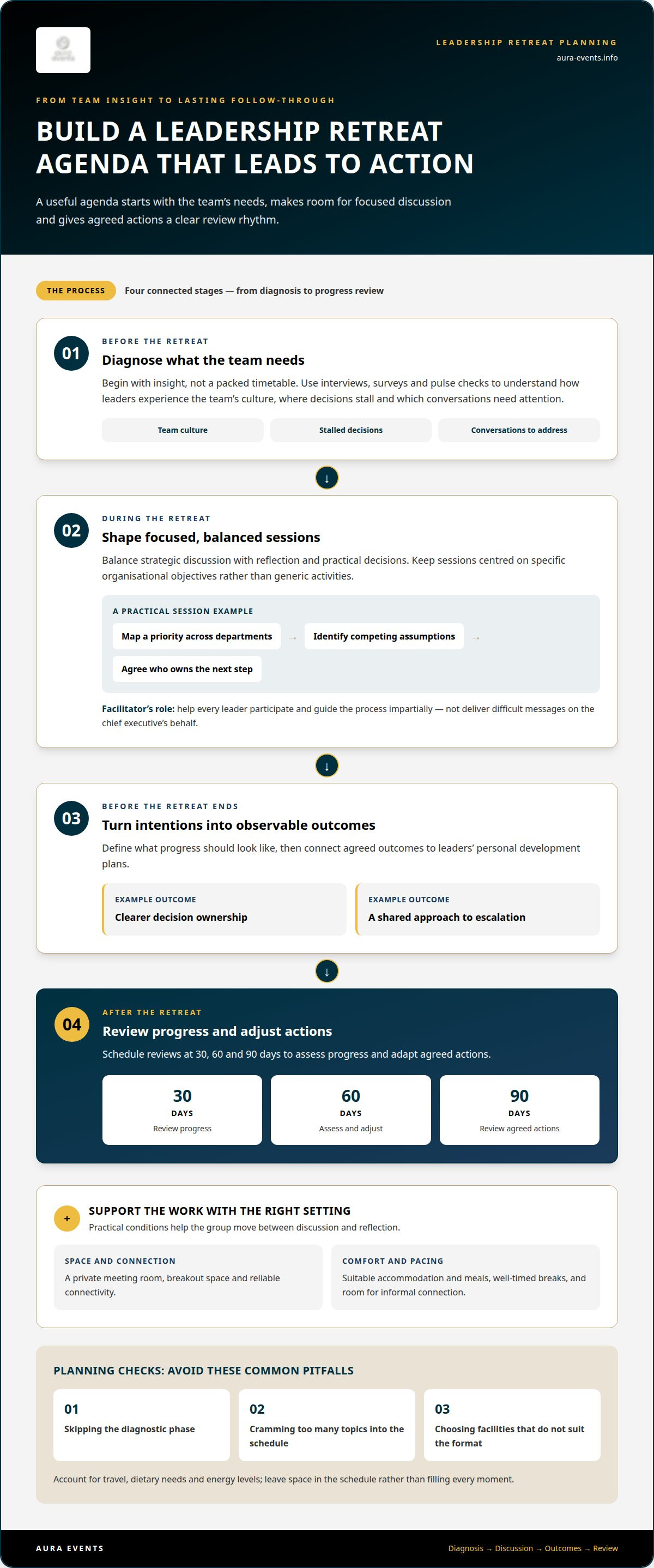
A credible agenda begins with a diagnostic phase, not a packed timetable. Interviews, surveys and pulse checks can reveal how leaders experience the team’s culture, where decisions stall and which conversations need attention. Those insights help shape focused sessions around specific organisational objectives, rather than generic activities.
The facilitator can then balance strategic discussion with reflection and practical decisions. For example, the team might map a priority across departments, identify competing assumptions and agree who owns the next step. An external facilitator can help every leader participate without also having to manage the discussion. Their role is to guide the process, not deliver difficult messages on the chief executive’s behalf.
A professional facilitator also turns broad intentions into objectives and measures. The team can define observable outcomes, such as clearer decision ownership or a shared approach to escalation, then connect them to leaders’ personal development plans. Schedule reviews at 30, 60 and 90 days to assess progress and adjust agreed actions.
The setting supports the work. A private meeting room, breakout space and reliable connectivity help the group move between discussion and smaller reflection sessions. Comfortable accommodation, suitable meals and well-timed breaks matter too: a schedule that overlooks travel, dietary needs or energy levels can undermine focus. Leave room for informal connection instead of filling every moment.
Common planning mistakes include skipping the diagnostic, cramming too many topics into the schedule, and choosing facilities that don’t suit the format. A skilled facilitator brings relevant leadership experience, impartiality and a clear process for handling disagreement. They should help the group reach decisions without steering it towards a predetermined answer. A professionally planned retreat can bring the agenda, setting and logistics into one coherent experience. Explore leadership retreat planning as a natural next step.
3. Addressing silos, misaligned priorities and low trust
An incoming chief executive can use the first 100 days to establish trust, working rhythm and expectations. A facilitated retreat creates space to examine how decisions travel between departments. For example, a product launch may rely on sales, finance and operations. If each function defines success differently, misalignment can emerge before delivery slips.
Start by getting “on the balcony”: observe patterns before prescribing fixes. Leaders can map where information stops, whose priorities conflict and which decisions repeatedly return to the executive. This adaptive leadership idea helps distinguish structural obstacles from relationship problems. The group can then consider clearer ownership, coaching or changes to team roles.
To strengthen trust, facilitate discussion around a live cross-department decision. Ask each leader to name the evidence they need, the risks they see and the support required. This makes disagreement visible without turning it into a personal contest. A norm of challenging proposals while respecting the person presenting them gives psychological safety a practical form. Leaders can practise this in a retreat before using it in routine meetings.
Purpose gives cross-functional work a shared test: does a decision advance the organisation’s agreed priorities? In a facilitated discussion, each leader can explain the implications for their function before the group settles on a direction. Team members are more likely to support a decision when they feel heard, even if it differs from their preference. This can strengthen alignment without requiring everyone to agree on every point.
Close by recording an owner, next action and review point for each commitment. For example, leaders might agree who will share a revised priority with their teams and how feedback will return to the executive group. These steps help the organisation carry decisions across departments and show where follow-through needs attention.
4. Signs a leadership team needs a retreat
A new leadership team retreat may be timely when routine meetings keep circling the same unresolved issues. Look for repeated misunderstandings, priorities that shift between departments, or decisions that return to the executive group without progress. These patterns can blur direction and make it harder for leaders to act clearly. One difficult meeting may be an exception; recurring behaviour points to a deeper challenge.
Consider three practical signals: communication breakdown that persists, initiatives stalling within 30 days of launch, and no real leadership retreat within the previous 12 months. Each points towards a different need. Communication problems may call for honest discussion; stalled work can expose unclear ownership; a long gap between retreats may leave little space to reset how the team works.
More than two warning signs can be a useful prompt to consider a retreat. If leaders avoid difficult conversations, disagree about priorities and repeatedly reopen settled decisions, for example, the combined pattern deserves attention. A new leadership team retreat can give the group focused time to examine what is driving these behaviours and decide what needs to change.
Before planning, clarify the challenge the team needs to address. Is the main issue trust, decision-making, communication between departments or a lack of shared direction? A short diagnostic conversation can help distinguish a structural gap from strained relationships. That distinction makes it easier to shape the retreat around the work required, rather than treating time away as the solution in itself.
After the retreat, look for evidence that agreed actions are changing daily leadership. Set a date to reconvene and review progress at 30, 60 and 90 days. If owners remain unclear or the same obstacles persist, revisit commitments and decide what further support is needed. For a team facing several warning signs, plan a focused leadership retreat around the challenges holding it back.
Aura Events: Ibiza Corporate Retreats
Aura Events designs and manages corporate retreats for leadership teams ready to turn shared priorities into purposeful time together. Its Ibiza Corporate Retreats give leaders a considered setting for strategic conversations and team connection, while tailored coastal and island environments offer an inspiring backdrop for a different kind of shared experience.
Turn to Aura Events when your team’s needs are clear and you are ready to shape a retreat around them. Team-building activities can form part of the programme, while Luxury Villa Sourcing helps create a fitting base for the gathering. The setting and activities should serve the retreat’s purpose, not distract from it.
To discuss a retreat shaped around your leadership team’s aims, contact Aura Events.
Give your team the space to move forward
The next step is to turn the need for change into a clear brief. Consider what your leaders should be able to do differently afterwards and what kind of setting will help them speak openly. A new leadership team retreat can mark a meaningful transition when its purpose shapes the experience, rather than the other way around.
Aura Events can shape the experience through Ibiza Corporate Retreats or Chamonix Leadership Offsites, with Luxury Villa and Chalet Sourcing helping create the right setting. The choice depends on the atmosphere and practical arrangements that suit your team’s aims.
Start a conversation about the retreat you have in mind. Contact Aura Events to plan your retreat, and take the next step towards a more connected leadership team.
Frequently Asked Questions
Will a Leadership Team Retreat Actually Improve Relationships?
It can, if leaders use the time to change how they work together afterwards. For example, a team might agree how to raise concerns when a project is at risk, then use that approach in its next planning meeting. A retreat creates the conditions for more candid connection, but its lasting value depends on whether leaders practise their agreements in everyday work.
What should a leadership retreat agenda include?
Include a clear purpose, time for strategic decisions and sessions that address the team’s current working challenges. A useful exercise is to map a significant decision: who advises, who decides and who communicates the outcome. End by recording decisions, owners and next steps. This gives the team a practical reference after the retreat, rather than relying on memories of the discussion.
Where can I get a leadership retreat planning guide?
Use this article as a starting point, then turn its ideas into a retreat brief. Set out the team’s main challenge, the decisions it needs to make, the intended outcomes and practical requirements for travel or accommodation. Aura Events can use that brief to shape an experience around your organisation, rather than applying a generic schedule that misses your team’s specific needs.
What are the benefits of a retreat for a newly formed leadership team?
A retreat gives newly appointed leaders a dedicated setting to understand one another’s expertise, responsibilities and expectations. Each person could explain what their function needs from colleagues before the team agrees how responsibilities overlap. That shared context can prevent assumptions from becoming entrenched working habits and give the group a clearer foundation for making decisions together.
What is the ideal length and agenda for a leadership team retreat?
Leadership development retreats often run for two to four days. The right agenda depends on the team’s purpose: allow time for focused strategic work, leadership reflection and conversations that need more than a brief meeting. Build in space to absorb decisions and agree next actions. A shorter programme may suit a single priority; broader organisational challenges need more room to explore.
Should a company use an external facilitator for a leadership retreat?
An external facilitator can help when the chief executive needs to contribute fully or when discussions involve sensitive disagreements. Their independence lets them guide participation and keep the conversation purposeful without taking ownership of the team’s decisions. An internal chair may suit a straightforward planning session, but an outside facilitator can be valuable when existing roles make neutral discussion difficult.


Comments