
International incentive travel experiences in the UK and overseas
A reward should be more than a change of scenery. International incentive travel gives businesses a way to recognise achievement through a thoughtfully designed trip, while encouraging employees to work towards shared goals and build stronger connections.
It’s understandable that organisations want a reward to feel memorable, not like another routine perk. The destination matters, but so does the purpose: a programme can recognise individual results, celebrate a team’s contribution or bring people together around a business objective.
This article explains what incentive travel involves and how it can support motivation, performance and loyalty. It also explores how to choose accommodation, venues and experiences, from UK settings such as London, Manchester and Bristol to European retreats in Ibiza and Chamonix-Mont-Blanc.
Table of Contents
Motivating employees with aspirational travel
Travel becomes a purposeful reward when it recognises achievement and gives people something meaningful to work towards. In an international incentive travel programme, the destination and experience should reflect the business goal.
Employee and Team Rewards
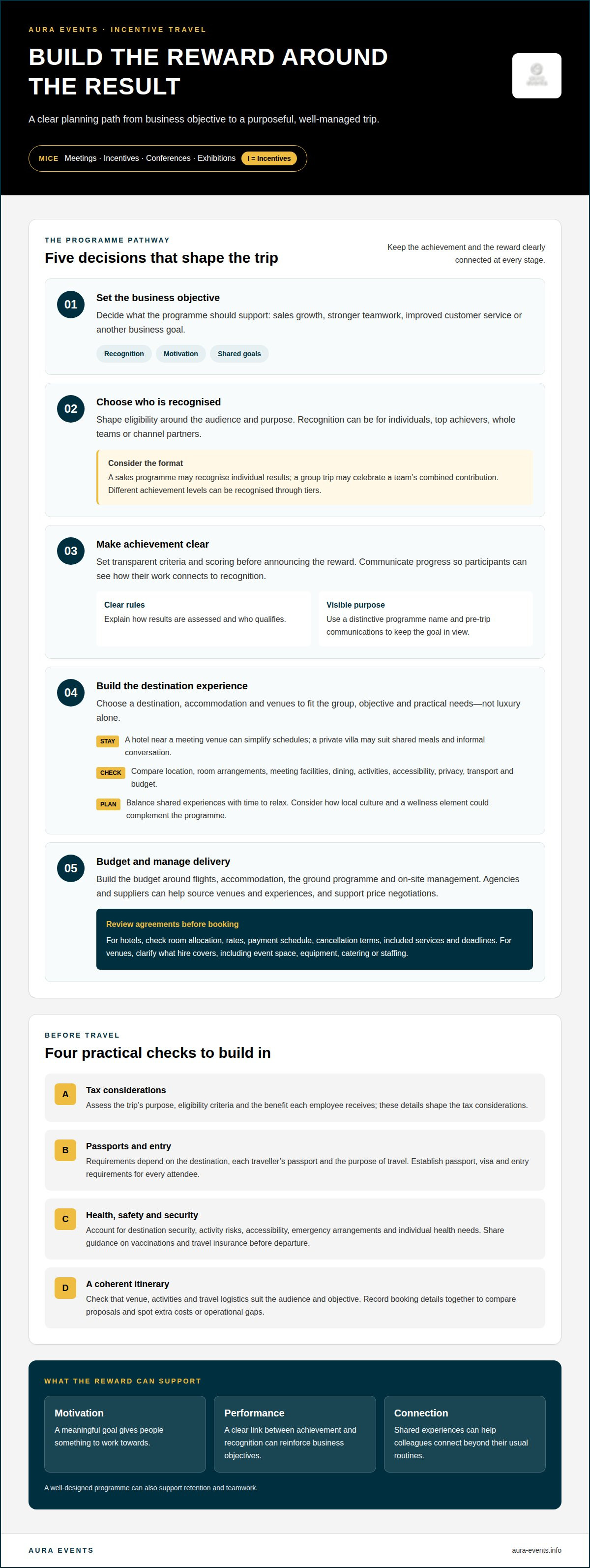
Decide whether the reward is for individual employees, a high-performing team or partners who contribute to business results. A sales programme might recognise top achievers, while a group trip could celebrate a team’s combined contribution. Set clear achievement criteria before announcing the reward so participants understand how recognition is earned.
Consider whether different achievement levels merit different rewards. A tiered structure can recognise a range of contributions, rather than only one top performer. If employees and partners travel together, include shared experiences that let everyone celebrate collectively while recognising individual effort.
Motivation and Engagement
Link the reward to a specific objective, such as sales growth, stronger teamwork or improved customer service. SITE describes incentive travel as a business tool for rewarding people and unlocking their potential to achieve corporate objectives. It also states that these programmes can strengthen retention, improve performance and foster thoughtful motivation.
Make the criteria transparent and communicate progress throughout the programme. Employees can then see how their work connects with the reward, rather than viewing it as an unexplained perk. A shared destination experience can also help colleagues from different teams or locations connect beyond their usual routines.
UK tax: Assess the trip’s purpose, eligibility criteria and the benefit each employee receives before setting the reward. These details shape the programme’s tax considerations.
Passports and entry: Requirements depend on the destination, each traveller’s passport and the purpose of travel. Build time into the planning process to establish passport, visa and entry requirements for every attendee.
Business benefits: A well-designed reward can connect performance goals with recognition, supporting motivation, retention and teamwork. The achievement and reward should feel clearly linked.
Health, safety and security: Account for destination security, activity risks, accessibility, emergency arrangements and individual health needs. Incentive travel planners should inform attendees about vaccinations and travel insurance, and provide clear guidance before departure.
Understanding the events industry: what is incentive travel?
Incentive travel is the “I” in MICE: meetings, incentives, conferences and exhibitions. A tailored programme uses travel to recognise achievement and gives a business a structured way to pursue its objectives.
Start with the outcome, then design the experience around it. A business seeking stronger collaboration might include shared activities, while a sales-focused programme could tie achievement criteria to performance. Clear scoring helps employees understand how results are assessed, and transparent rules reduce confusion about who qualifies. A distinctive programme name and pre-trip communications can keep the reward’s purpose visible.
Programmes can recognise individuals, selected top achievers or whole teams. Achievement-based tiers offer different levels of recognition, while sales or channel-partner programmes can include people beyond the company’s employees. The right structure depends on the audience and objective. A group programme might bring departments together around a shared experience or recognise separate teams through one destination and central itinerary.
Reach can be local to one team or extend across partners and global offices. For a wider group, consistent eligibility and scoring matter, while the destination experience can be adapted to different needs. Agencies and suppliers help turn the design into a workable itinerary; their local relationships can support venue and experience sourcing, as well as price negotiations.
For UK businesses planning and budgeting an overseas programme, define the objective, eligible participants and scoring approach first. Build the budget around flights, accommodation, the ground programme and on-site management, then choose a destination and experiences that fit those priorities.
A wellness element can suit programmes focused on restoration and shared time. Consider how wellness and spa programmes could complement the itinerary, without distracting from the reward’s purpose.
Accommodation and venue recommendations
Choose accommodation and venues for the programme’s purpose, not luxury alone. A hotel near a meeting venue can simplify schedules, while a private villa may suit a group seeking shared meals and informal conversation. Consider how the setting reflects local culture and inspires participants, alongside practical needs such as accessibility, privacy and transport.
Compare hotels and venues against the same requirements: location, room arrangements, meeting facilities, dining, activities and budget. A central property may reduce ground transport, while a rural setting could offer more privacy but require additional logistical planning. Include entertainment in the programme design, whether that means a hosted dinner, a guided local experience or time to enjoy the destination.
Review hotel contracts carefully before booking. Check the agreed room allocation, rates, payment schedule, cancellation terms, included services and deadlines. For a venue, clarify what the hire covers, such as event space, equipment, catering or staffing. Recording these details in one schedule makes proposals easier to compare and helps identify extra costs or operational gaps.
To compare incentive travel agencies and destinations, assess how well each proposal matches the audience, objectives, travel logistics and budget. Local supplier relationships can support venue, activity and experience sourcing, as well as price negotiations. Look for a coherent programme, not simply an appealing hotel or a long list of options.
Plan and book in sequence: set the objective and budget, define the group’s needs, shortlist destinations, then source accommodation and venues. Once you select a preferred option, agree contract terms and coordinate transport, catering, activities and timings. This order helps each booking support the same experience.
For a more private group stay, luxury villa and chalet sourcing can provide an alternative to conventional hotels. Match the property style and setting to the group’s purpose, then coordinate the venue with the wider itinerary.
Incentive travel experiences in the UK and overseas
The right destination gives a corporate reward its character. In the UK, London, Manchester and Bristol offer distinct city settings for hosted meals, cultural visits and time together. These options keep the trip within the country while providing a change of scene from everyday work. Match the destination to the achievement being recognised, rather than choosing a venue for prestige alone.
Overseas locations bring a different atmosphere. Amsterdam offers a European city experience, while Ibiza can frame a coastal programme and Chamonix-Mont-Blanc an Alpine one. Each setting lends itself to a different pace and style of travel. Make room for connection, planned experiences and time to enjoy the surroundings.
For a UK workforce, compare destinations through practical details as well as atmosphere. Consider journey connections, the group’s travel needs, programme pace and the experiences available at each venue. A city-based stay in Manchester or Amsterdam may suit a programme centred on culture and dining, while a more scenic destination can give the reward a stronger sense of escape. The best fit depends on the purpose and participants.
Experiences can make awards feel personal. A team recognised for collaboration might share a guided activity, while a reward for individual achievement could include a memorable meal in a distinctive setting. Shape the itinerary around the group’s interests and the achievement being celebrated. This makes the trip feel intentional, rather than a standard break with a corporate label.
For an overseas reward shaped around coastal scenery, local character and time together, plan an Ibiza corporate retreat. Choose experiences that reflect the achievement, then let the destination give the celebration its own atmosphere.
Use these ranges to set expectations early and weigh the scale of the reward against its purpose and the group’s priorities.
Aura Events
Aura Events designs and manages high-end incentive travel around your business objectives, destination and people. Turn to the team when you’re ready to move from ideas to a considered programme, with the setting, accommodation and experiences brought together in one itinerary.
For example, an Ibiza corporate retreat can bring a group together in a coastal setting, while a Chamonix leadership offsite offers an Alpine backdrop. Aura Events can arrange luxury villa and chalet accommodation, private yacht charters, catering and private chef services, and private transport to support the itinerary.
Start with a clear sense of what the reward should recognise and how you want participants to spend their time. Share your objectives with Aura Events to discuss your incentive travel plans.
Make the next reward purposeful
Decide what you want the experience to make possible after everyone returns. Stronger connections between teams, renewed focus on a shared goal or recognition that feels genuinely personal can each shape a different programme. Let that intended impact guide the choices, from the destination’s atmosphere to the pace of the itinerary.
Aura Events can help bring that intention into focus through Ibiza Corporate Retreats, Chamonix Leadership Offsites and Luxury Villa and Chalet Sourcing. Each offers a different setting for an incentive, with the programme shaped around your people and priorities. For international incentive travel to feel distinctive, the experience should belong to your organisation, not follow a familiar template.
Share the outcome you want to encourage and the kind of experience you have in mind. Contact Aura Events about incentive travel to explore the possibilities and begin shaping a reward with purpose.
Frequently Asked Questions
What is international incentive travel and how does it work?
International incentive travel is a business reward programme built around a trip abroad. A company sets participation criteria, explains how employees qualify, then arranges a destination experience for those who meet them. For example, a programme might recognise a sales milestone with a hosted itinerary. Afterwards, compare the results with the original objective to inform future rewards.
Which destinations are popular for international incentive trips from the UK?
Ibiza and Chamonix-Mont-Blanc offer UK businesses distinct settings for a corporate reward. Ibiza can suit a coastal itinerary, with private boat days to Formentera among the experiences in Aura Sun. Chamonix offers an Alpine backdrop, with guided skiing and snowboarding across multiple resorts as part of Aura Snow. The best fit depends on the group’s interests, travel arrangements and the atmosphere the business wants to create.
How can businesses measure the ROI of an international incentive travel programme?
Measure ROI by comparing the programme’s full cost with the value linked to its business objective. Set a baseline before launch, then track relevant indicators afterwards, such as sales against target, employee participation or partner-generated business. Record the same measures consistently and note other factors that may affect results. This gives decision-makers a clearer view of the programme’s contribution, beyond attendee enjoyment alone.


Comments